
Understand · what it is and why it exists
01What it is
Opening conditions are the facts of the first thirty minutes: where the market opened relative to yesterday's close (the gap), whether it moved toward or away from that close (the first test), how wide the first minutes' range was (the opening range), and how much volume came with it.
Those facts are the market's first statement about the day. Overnight information — earnings, foreign markets, data released at 7:30 Central — is priced in the opening minutes. The way that pricing happens tells you how participants are positioned and how convinced they are.
Reading the open is not predicting the day. It is collecting the evidence that will let you label the day by the end of the first hour — and knowing which trades the open tends to work against.
02Why it exists
The open is different because information and orders accumulate overnight and are released all at once. Every earnings report, every headline, every move in Asia and Europe arrives at 8:30 Central as a single opening print. That concentration makes the first minutes volatile, wide-spread, and unusually informative.
It also exists because of positioning. Participants who were wrong overnight must act at the open; those who were right can press. The first test of the prior close is where those two groups meet, and which one wins says something about the rest of the day.
03How it is measured or observed
The observations that make up an opening read:
- The gapOpen minus prior close, as a percentage. Large gaps (more than the stock's typical daily range) signal real overnight information; small gaps are noise.
- Gap fill or holdIn the first 15–30 minutes, does price return to the prior close (fill) or move further away (hold)? A held gap on volume is a trend-day clue; a quick fill is a range-day clue.
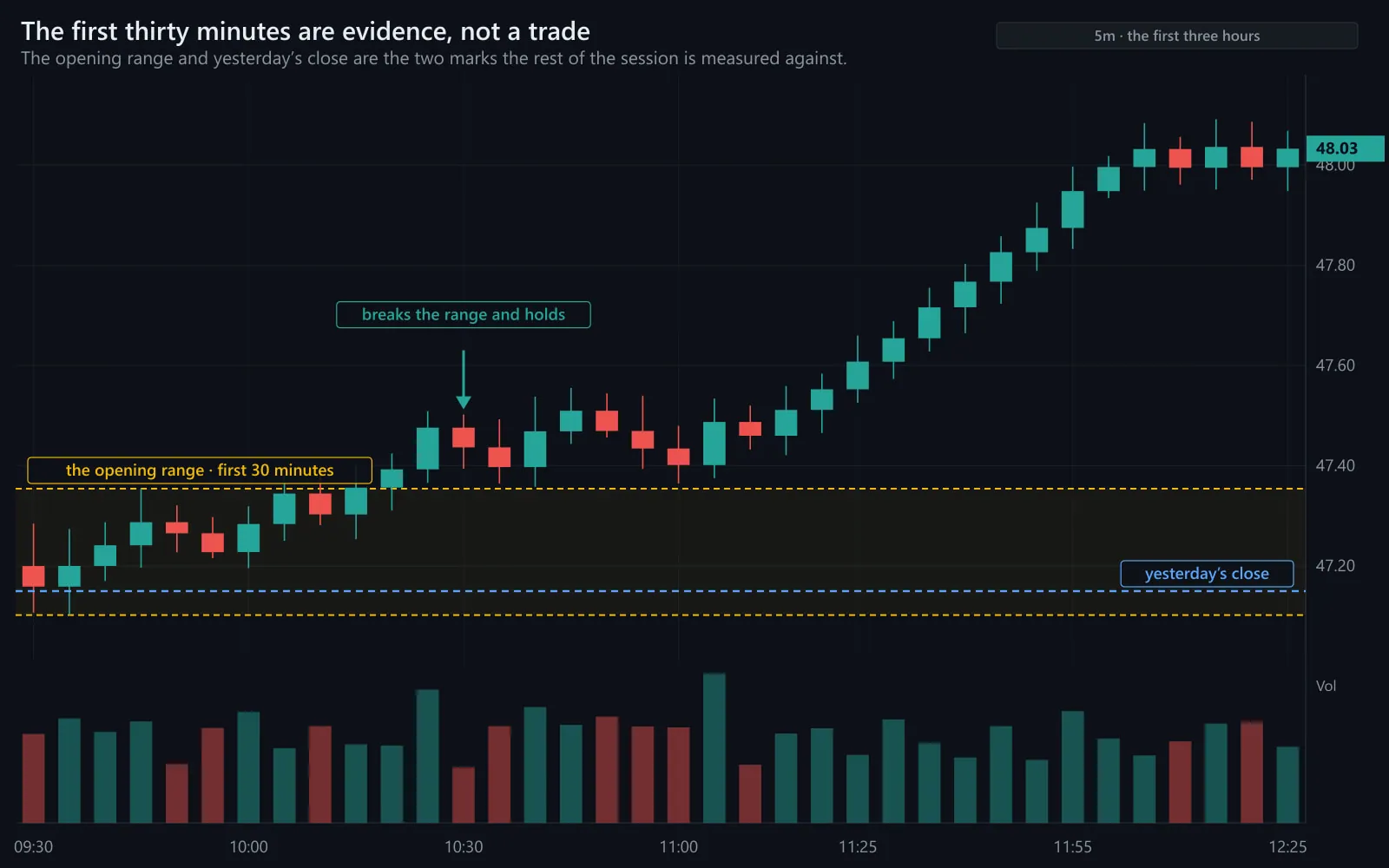
- Opening rangeThe high and low of the first 5, 15 or 30 minutes. Breaking out of it and staying out is informative; breaking and re-entering is informative in the other direction.
- Opening volumeVolume in the first half hour versus a normal day. Heavy volume with a held gap means conviction; heavy volume with a reversal means a fight.
- Breadth at the openAdvancers versus decliners in the first minutes. One-sided from the start is a trend signature.
- Pre-market levelsThe pre-market high and low. Price respecting or breaking them in the first minutes is the first test of the day's levels.
Read · seeing it in the market
04How professionals read it
Many professionals read the first minutes rather than trade them. Spreads are wide, prices are finding their level, and the earliest moves reverse often. The first five to fifteen minutes are for observation: the gap, the first test, the early breadth.
They watch the first test of the prior close like a referee. Price gaps up, pulls back toward yesterday's close, and either holds above it (buyers defending; the gap is real) or cuts through it (the gap was an overreaction; sellers are in charge). That one test is often the most informative minute of the day.
They mark the opening range and then wait for price to declare itself. Leaving the range on expanding volume and not coming back is the start of a trend-day label; breaking the range and returning inside is the start of a range-day label. Either way, the label is provisional until the first hour ends.
And they respect known events. On days with a 7:30 Central data release, the open already contains the reaction; on days with a 1:00 PM Fed decision, the morning is positioning and the afternoon is the driver. The calendar decides how much the open can tell you.
05What strength looks like
A convincing open: a gap on heavy volume, a shallow first test that holds well above the prior close, the opening range broken to the upside and not revisited, breadth one-sided from the start. The market is saying the overnight information was real and participants agree on its direction.
Illustrative. Price opens above the prior close (grey line at 100), tests toward it, holds, and leaves the opening range — a trend-day opening.
Source: illustrative teaching data — not market data
06What weakness looks like
An unconvincing open: a gap on ordinary volume, a first test that slices through the prior close, the opening range broken and re-entered, breadth flipping. The overnight news was priced and then faded. That is a range-day opening, and chasing the gap runs against it.
Illustrative. Price opens above the prior close, fails the first test, fills the gap and chops — a range-day opening.
Source: illustrative teaching data — not market data
07What a divergence looks like
The opening divergence worth knowing is a gap with the wrong volume: a large gap on thin volume is suspicious (few participants endorsed it), and a small gap on enormous volume is significant (a fight is under way). Volume tells you how many people agreed with the price.
Trend-day opening
- Large gap on heavy volume
- First test of prior close holds
- Opening range broken and not revisited
- Breadth one-sided from the start
- Pre-market levels respected
Range-day opening
- Gap on ordinary volume
- First test cuts through prior close
- Range broken then re-entered
- Breadth flipping
- Pre-market levels chopped through
What each clue points toward.
Interpret · what it means for you
08What it means for an investor
For an investor the open is mainly a time for caution. Spreads are widest and prices least settled in the first minutes; a market order at 8:31 Central often fills worse than a limit order at 9:15. On a gap day, some investors wait for the first test to resolve before acting.
09What it means for a trader
For a trader the open is evidence, not opportunity. The Advanced program's rule is to observe the first minutes, mark the range, watch the first test, and decide TRADE or NO TRADE with a reason — which is exactly how the replayed opening sessions are run. A common beginner loss is buying a gap at 8:32 that fills by 8:50.
10What it cannot tell you
- The open does not decide the day. Trend openings fail; range openings resolve into afternoon trends.
- A gap's size says little without its volume and its first test.
- The first minutes' direction reverses often enough that it is unreliable on its own.
- Opening reads are least reliable on days with a scheduled afternoon event; the real driver has not arrived yet.
Apply · the market right now
11What is happening right now
MAAL TRADING ACADEMY market note
No dated note has been published for this topic yet. We only publish current-market commentary written and dated by the academy — nothing auto-generated.
Data · previous close
Live levels for SPY, QQQ appear here once the licensed market-data feed is connected. We do not show unlicensed or made-up numbers.
How to check this yourself today
- Before the open: note yesterday's close, the pre-market high and low, and any 7:30 CT data release.
- At 8:30 CT: record the gap as a percentage and the first-five-minute volume versus a normal day.
- By 8:45 CT: did the first test of the prior close hold or fail? Mark the opening range.
- By 9:30 CT: is price outside the range and holding, or back inside? Assign a working label.
12Visual market example
Two opens on the same axis. Both gap up. One tests the prior close, holds, and leaves the range — the overnight news was real. The other cuts through the prior close inside fifteen minutes and fills — the news was already priced, or wrong. Same gap, opposite days, decided by one test.
Illustrative. A held gap (navy) and a filled gap (grey) against the prior close.
Source: illustrative teaching data — not market data
Review · practise, keep, connect
13Test your understanding
Read the chart the way you would before a trade. Pick the answer, then read why.
1SPY gaps up 1.1% on heavy volume after strong earnings from a giant. In the first ten minutes it pulls back to 0.3% above the prior close and holds, then breaks above the opening range. What is the working read?
Illustrative.
Source: illustrative teaching data — not market data
14Key takeaways
- The first thirty minutes price all overnight information at once — they are for reading more than trading.
- The first test of the prior close is often the most informative minute of the day.
- Mark the opening range; leaving it and holding is one label, re-entering it is the other.
- Volume tells you how many people agreed with the gap.
- An opening read is evidence for a working label by 9:30 Central, not a prediction of the close.
16Learn it in class
Advanced Program · Stage 3 · Trading the Opening Bell
Advanced: replayed opening sessions — pause, rewind, compare — where every student calls TRADE or NO TRADE on the first test and explains why.