
Understand · what it is and why it exists
01What it is
Every session has a driver: the thing most participants are reacting to. Some days it is obvious — a rate decision at 1:00 PM Central, a giant company's earnings the night before. Some days it is quieter: positioning into a known event, a move in bond yields, a sector-specific headline. And some days there is no driver at all, and the honest answer is 'nothing much'.
Knowing the driver matters because it tells you what the move depends on. A rally driven by falling yields can reverse when yields turn; a rally driven by one company's earnings is contained to its neighbourhood; a rally with no driver is often a range day that fades. The driver is the context every trade sits inside.
The skill is not predicting the driver. It is identifying it in real time, from the market's own behaviour, rather than from the explanation a headline writer attaches at 3:05 PM.
02Why it exists
Markets move on information and on positioning. Information arrives on a schedule (economic data, earnings, central-bank meetings) and without one (news, guidance changes, geopolitics). Positioning is how participants are already placed before it arrives, which decides how hard the reaction is.
The same piece of news can produce a rally or a sell-off depending on what was expected and who was positioned for it. That is why the driver of a session is a combination of what happened and how the crowd was leaning — and why the market's reaction, not the news itself, is the thing to read.
03How it is measured or observed
Drivers are identified by looking at where the move is concentrated and what else moved with it:
- The calendarKnown events: Fed decisions, inflation (CPI) and jobs data, major earnings. If the move starts at the minute of a release, the driver is rarely a mystery.
- Bond yieldsThe 10-year Treasury yield. Stocks often move opposite to it on rate-driven days; when yields jump and growth stocks fall together, rates are the driver.
- Sector dispersionIf one sector moves hard and the rest are flat, the driver is sector-specific. If everything moves together, it is macro.
- Leadership within the moveAre the biggest movers the most rate-sensitive names, the most speculative, the most defensive? The identity of the movers points to the cause.
- Volume and breadthA real driver produces expanded volume and one-sided breadth. A quiet drift on thin volume usually has no driver worth naming.
- Cross-asset confirmationThe dollar, gold, oil, credit. A driver that is genuinely macro shows up in more than one market.
Read · seeing it in the market
04How professionals read it
Professionals start with the calendar the night before. They know what is scheduled, what the consensus expects, and roughly how the market is positioned into it. That preparation means that when the move happens, they are identifying, not guessing.
They then read the reaction rather than the headline. A 'good' earnings report that sends a stock down is telling you expectations were higher than the number — the driver is the gap between the two. Data that 'should' have been bad but produced a rally is telling you about positioning. The market's reaction is the fact; the headline is commentary.
They are suspicious of stories. By the close, every move has an explanation attached, and most of them were written backwards. If the driver cannot be located in the market's own behaviour — where the move started, what moved with it — it is probably not the driver.
And they accept 'no driver' as an answer. Plenty of sessions are positioning, noise and drift. Forcing a narrative onto those days is how people trade things that are not there.
05What strength looks like
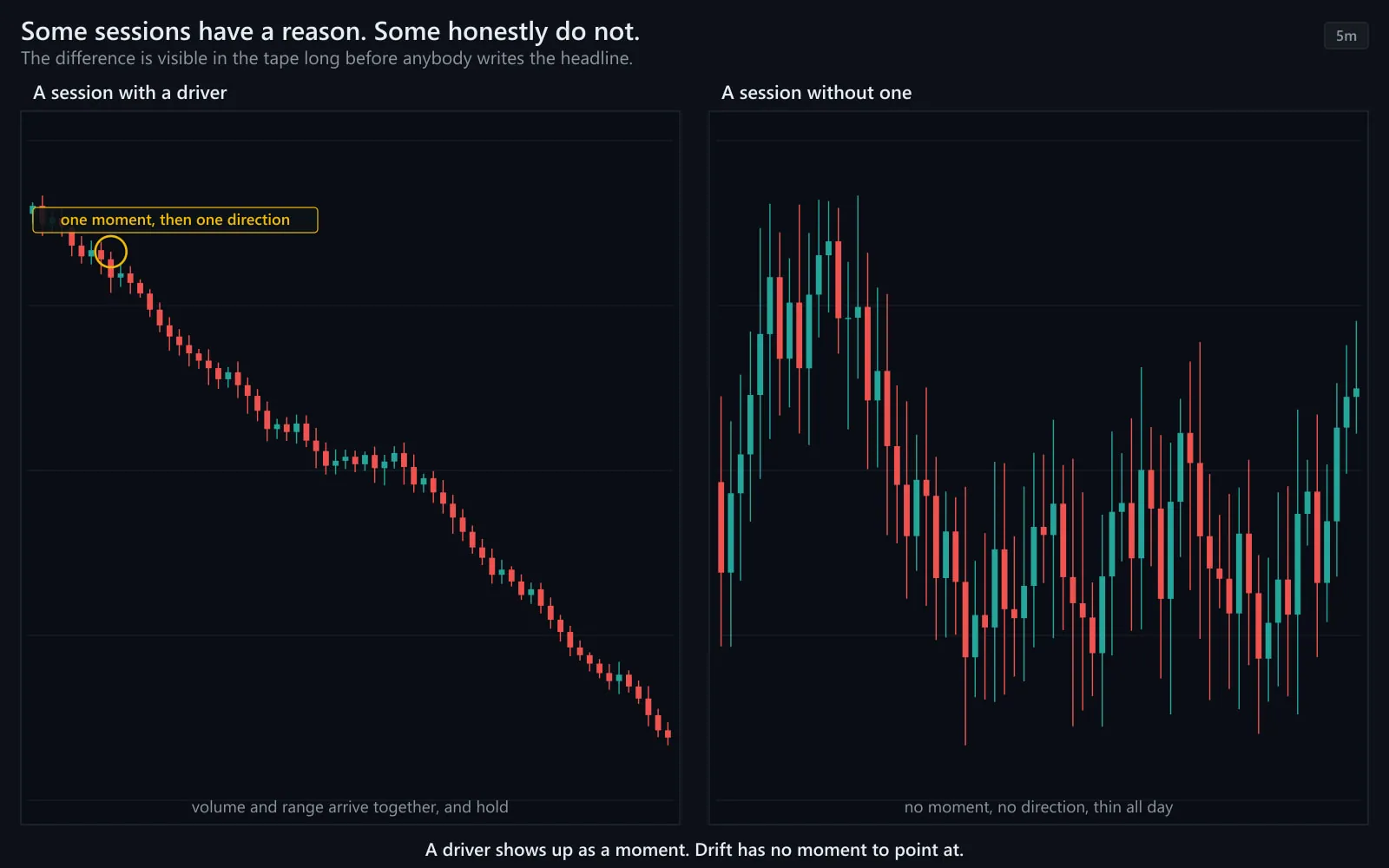
A session with a clear driver looks coherent: the move starts at an identifiable moment, volume expands, breadth goes one-sided, related markets confirm, and the groups that should move on that driver are the ones moving. Rates fall, growth stocks lead, small caps rally — one story, every piece consistent.
Illustrative. Range behaviour until a catalyst lands at the midpoint; then a sustained one-way move — a real driver.
Source: illustrative teaching data — not market data
06What weakness looks like
A session without a driver looks like drift: no identifiable start, thin volume, mixed breadth, sectors pointing different ways, and a move that reverses as easily as it began. The explanations attached to it afterwards are usually wrong because there was nothing to explain.
Illustrative. Aimless two-sided movement on no catalyst — there is no story here, whatever the close says.
Source: illustrative teaching data — not market data
07What a divergence looks like
The divergence here is between headline and reaction. When the news is good and the market falls, or the news is bad and the market rises, the driver is positioning and expectation, not the news. Those sessions are among the most informative of all because they reveal what the crowd was actually waiting for.
Real driver
- Move starts at an identifiable time
- Volume expands; breadth one-sided
- The right groups move for that cause
- Other markets confirm (yields, dollar, credit)
- Reaction fits the positioning
Invented story
- No clear start; drift
- Thin volume; mixed breadth
- Movers don't match the stated cause
- Other markets indifferent
- Explanation appears after the close
How to tell them apart before the close.
Interpret · what it means for you
08What it means for an investor
An investor does not need to know today's driver, but benefits from knowing the kind of driver a market is running on. A market driven for months by falling rates is a different holding than one driven by earnings growth, because what can end it is different. It is the difference between owning something and understanding what you own.
09What it means for a trader
For a trader the driver sets the playbook. Rate-driven days move growth and small caps together — traders read them as a group and watch yields for the turn. Earnings-driven days concentrate in a stock and its neighbours — the reaction matters more than the number. Driverless days tend to be range days — traders look to the edges or stand aside. Misidentifying the driver is how the right setup gets traded in the wrong context.
10What it cannot tell you
- The driver does not tell you how far the move goes. A strong catalyst can be fully priced in ten minutes.
- Headlines are not drivers. The reaction is. Many confident explanations are written backwards.
- 'No driver' is a legitimate reading and often the right one. Not every day means something.
- A driver can change mid-session — an afternoon headline can overwrite a morning catalyst.
Apply · the market right now
11What is happening right now
MAAL TRADING ACADEMY market note
No dated note has been published for this topic yet. We only publish current-market commentary written and dated by the academy — nothing auto-generated.
Data · previous close
Live levels for SPY, QQQ, IWM appear here once the licensed market-data feed is connected. We do not show unlicensed or made-up numbers.
How to check this yourself today
- Before the open, list the day's scheduled events and times (economic calendar, earnings before and after the bell).
- At the first significant move, note the time. Does it match a release?
- Check the 10-year yield, the dollar and the sector table: what moved with the index?
- Look at volume against the 20-day average and at advancers versus decliners. Real drivers leave footprints.
12Visual market example
Rates as the driver: over several weeks yields fall steadily and growth stocks rise in a near mirror image. No single session needs its own story — the same driver explains all of them. The day yields reverse is the day to watch the growth leaders most closely.
Illustrative. Yields (grey) fall while growth stocks (gold) rise — one driver, many sessions.
Source: illustrative teaching data — not market data
Review · practise, keep, connect
13Test your understanding
Read the chart the way you would before a trade. Pick the answer, then read why.
1A large company reports earnings that beat expectations. The stock opens up 4% and closes down 6% on heavy volume. What was the driver of the close?
Illustrative.
Source: illustrative teaching data — not market data
2The index closed up 0.3% on the lowest volume in a month, breadth was even, and sectors were mixed. The evening headline says 'Stocks rise on optimism'. What drove the session?
Illustrative.
Source: illustrative teaching data — not market data
14Key takeaways
- Every session has a driver or honestly has none. Identify it from behaviour, not headlines.
- Prepare with the calendar; confirm with yields, sectors, volume, breadth and other markets.
- The reaction is the fact. Good news sold and bad news bought reveal positioning.
- The driver decides the playbook: rates, earnings or nothing each call for a different approach.
- Most end-of-day explanations are written backwards. Be suspicious of the tidy ones.
16Learn it in class
Advanced Program · Stage 1 · Finding Stocks in Play · Stage 3 · Trading the Opening Bell
Advanced Day 1 starts with catalysts and the calendar; the replayed opens are read the same way — what started the move, and did the market agree with the headline?