
Understand · what it is and why it exists
01What it is
The Dow Jones Industrial Average is an index of thirty large, established U.S. companies chosen by a committee to represent the economy broadly: industrials, healthcare, financials, technology, consumer. DIA is the ETF that owns them.
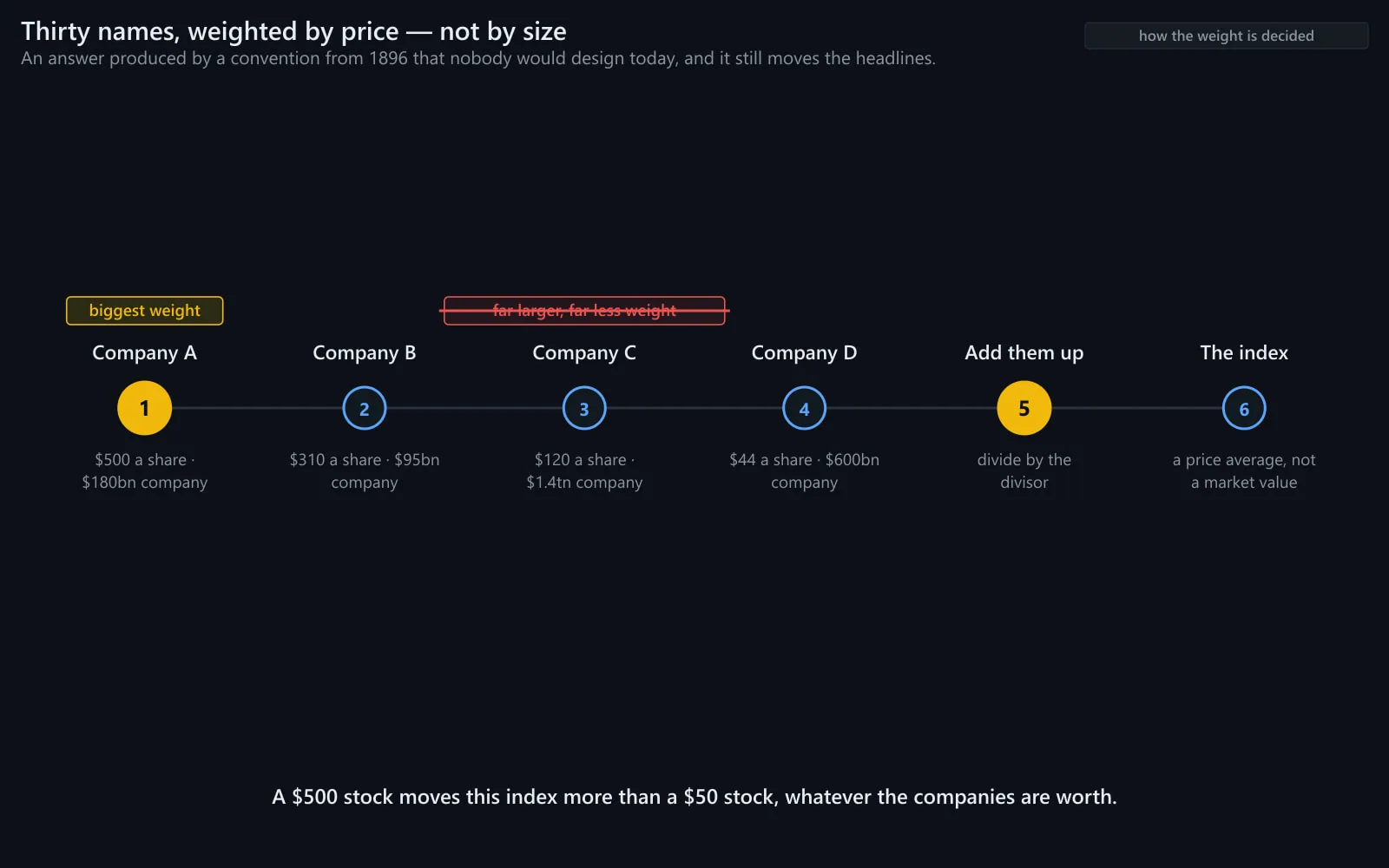
What makes the Dow unusual is how it is weighted. Every other major index weights companies by market value. The Dow weights them by share price: a company whose shares trade at $400 counts ten times as much as one whose shares trade at $40, regardless of which company is actually bigger. The divisor that turns thirty prices into one number has been adjusted for over a century of splits and substitutions.
That is why 'the Dow fell 300 points' is the most quoted and least informative sentence in financial news. Three hundred points might be 0.7%, and most of it might have come from two high-priced members.
02Why it exists
The Dow exists because it came first. Created in 1896 as a simple average of a dozen industrial stocks, it was the market's summary number for decades before broader, better-constructed indexes existed. Its age is why it is still quoted; its construction is why professionals rarely use it.
It persists as a cultural reference point more than an analytical one. When the general public hears 'the market', many still picture the Dow — which is worth knowing, because that is the number that moves public mood.
03How it is measured or observed
The Dow is best read by translating it into things that actually carry information:
- Percent, not pointsAlways convert the move to a percentage. 300 points on 40,000 is 0.75% — an ordinary day.
- Highest-priced membersIdentify the few members with the highest share prices. Their moves drive the index; a split changes a company's influence overnight without changing the company.
- Dow vs S&P 500When the two diverge, it is usually because of a handful of high-priced Dow members or because the Dow's smaller technology weight is lagging or leading the S&P's.
- Dow TransportsA companion index of transportation companies. 'Dow Theory' watches whether industrials and transports confirm each other's highs.
- CompositionThirty names, chosen by committee, changed occasionally. Knowing what was added or removed explains some long-run differences from the S&P.
Read · seeing it in the market
04How professionals read it
Professionals read the Dow mostly to understand what the public is reacting to. A large round-number point move makes headlines and moves sentiment even when the percentage is unremarkable. Knowing that helps explain retail flows at the open and the close.
Analytically, they use it sparingly. Thirty price-weighted stocks cannot describe a market of thousands. When it diverges from the S&P 500, the first question is which high-priced member moved, not what the economy is doing.
The one serious use is Dow Theory's confirmation idea: when the industrial average makes a new high and the transportation average does not, the economy's 'makers' and 'movers' disagree. It is an old idea and a slow one, but it is a legitimate breadth check across two groups.
05What strength looks like
The Dow at its most informative is when it agrees with everything else: tracking the S&P 500, transports confirming, its members rising broadly rather than on one or two expensive shares.
Illustrative. When DIA (grey) tracks SPY (navy), the Dow's quirks are not distorting the picture.
Source: illustrative teaching data — not market data
06What weakness looks like
The Dow is at its least informative when one or two high-priced members dominate its move — a single stock falling 10% after earnings can account for most of a triple-digit point drop while the other twenty-nine are flat. That is not market weakness; it is index construction.
Illustrative. A 10% drop in the highest-priced member can outweigh modest gains across the rest.
Source: illustrative teaching data — not market data
07What a divergence looks like
Dow Theory's divergence: industrials at a new high, transports well below. The classic interpretation is that goods are being made but not shipped — demand may be softer than the headline suggests. It is slow and has produced false signals, but it is one of the oldest breadth ideas in the market.
Informative
- Percentage move in line with the S&P
- Broad participation among the thirty
- Transports confirming industrials
- Composition understood
Misleading
- A headline points number
- One high-priced member doing the work
- A recent stock split changed the weights
- Read as 'the market'
Translate before you interpret.
Interpret · what it means for you
08What it means for an investor
For an investor DIA is a concentrated, large-cap, quality-tilted holding — thirty mature companies with a value lean compared with the S&P 500. It has tracked the broad market reasonably over long periods, but it is a narrow way to own it. Broader indexes describe the market more fully; the Dow is mainly something to understand.
09What it means for a trader
For a trader the Dow is background. The useful exceptions: round-number levels (every thousand points) attract attention and flows, and a high-priced Dow member reporting earnings can move the index in a way that briefly confuses the tape. Otherwise traders generally read SPY and QQQ instead.
10What it cannot tell you
- Its point moves carry almost no information without conversion to percent.
- Thirty stocks cannot describe the market. Breadth, small caps and most sectors are invisible to it.
- Price weighting means a stock split changes a company's influence with no change in the company.
- A Dow/S&P divergence is usually about a few members, not about the economy.
Apply · the market right now
11What is happening right now
MAAL TRADING ACADEMY market note
No dated note has been published for this topic yet. We only publish current-market commentary written and dated by the academy — nothing auto-generated.
Data · previous close
Live levels for DIA, SPY, IYT appear here once the licensed market-data feed is connected. We do not show unlicensed or made-up numbers.
How to check this yourself today
- Convert the Dow's last move to a percentage and compare it with SPY's.
- Identify the three highest-priced Dow members and check their recent moves.
- Compare the Dow Industrials with the Dow Transports over three months — do the highs confirm?
12Visual market example
Most of the time the Dow and the S&P tell the same story with different numbers. The days they don't are almost always explained by a single high-priced member — which is the whole reason to translate points into percent and look at the members before reading anything into the gap.
Illustrative. DIA and SPY over the same period — the gaps are construction, not information.
Source: illustrative teaching data — not market data
Review · practise, keep, connect
13Test your understanding
Read the chart the way you would before a trade. Pick the answer, then read why.
1The Dow falls 450 points (about 1.1%). The S&P 500 is down 0.2%. One Dow member with a $500 share price fell 12% on earnings. What happened?
Illustrative.
Source: illustrative teaching data — not market data
14Key takeaways
- The Dow is thirty stocks weighted by share price — quoted everywhere, used analytically almost nowhere.
- Translate points into percent before reading anything into a move.
- Divergences from the S&P are usually one or two high-priced members, not the economy.
- Dow Theory's industrials/transports confirmation is its one serious analytical use.
- Understand it because the public reacts to it; traders generally read and benchmark against SPY and QQQ.
16Learn it in class
Beginner Program · Stage 3 · How the Stock Market Works
Beginner Day 1 covers what the number in the news actually is — and why 'the Dow fell 300 points' is the sentence you learn to translate first.