Understand · what it is and why it exists
01What it is
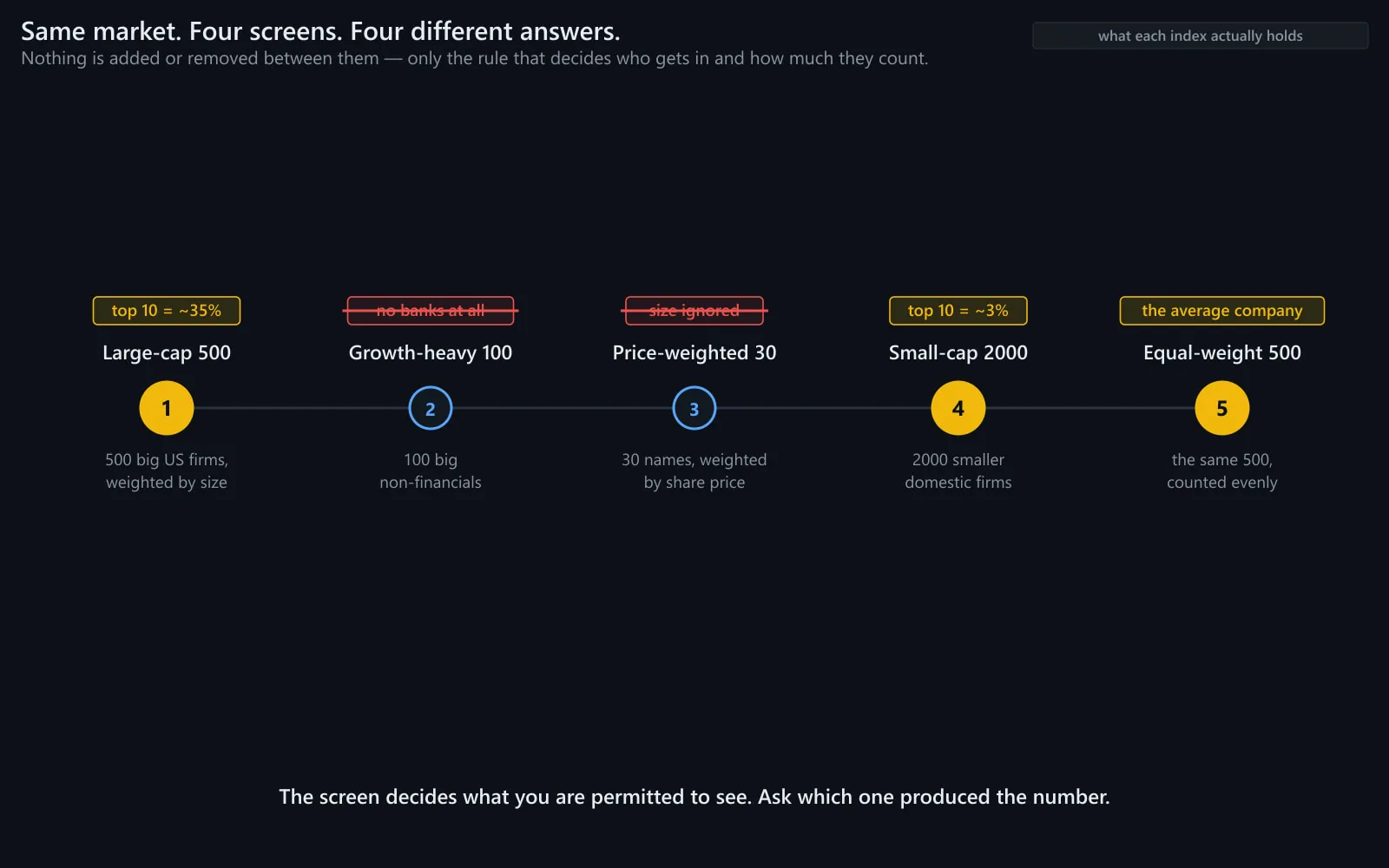
Every index is a decision about which companies to count and how much each should count. The S&P 500 counts the five hundred largest by value. The Nasdaq-100 counts the hundred largest non-financial companies on one exchange by value. The Dow counts thirty chosen companies by share price. The Russell 2000 counts two thousand small companies by value.
Those decisions are not details. They decide what the index can see and what it is blind to. The S&P 500 sees large U.S. companies and nothing smaller. QQQ sees growth and nothing financial. The Dow sees thirty names through a price-weighting quirk. The Russell sees the small domestic economy and no giants.
'The market' is therefore never one thing. It is whichever lens you picked up, and each lens describes a different market.
02Why it exists
Different indexes exist because different questions need different answers. 'How did large U.S. companies do?' is the S&P. 'How did growth do?' is the Nasdaq-100. 'How did small companies do?' is the Russell. 'What number does the public watch?' is the Dow.
They also exist because of history and ownership. Each was built by a different company for a different purpose at a different time, and each survived because enough money benchmarked against it. Indexes are institutions as much as measurements.
03How it is measured or observed
The four lenses, side by side:
- S&P 500 · SPY~500 large U.S. companies · cap-weighted · all sectors · top ten ≈ a third of the index. Sees: large-cap America. Misses: small caps, the world.
- Nasdaq-100 · QQQ100 largest non-financial Nasdaq companies · cap-weighted · heavy technology and growth · top ten ≈ half. Sees: growth. Misses: banks, most of the economy's 'old' sectors.
- Dow · DIA30 committee-chosen large companies · price-weighted · quality/value lean. Sees: thirty household names. Misses: almost everything; its weighting distorts even what it sees.
- Russell 2000 · IWM~2,000 small U.S. companies · cap-weighted · heavy financials, healthcare, industrials · many unprofitable. Sees: the small domestic economy. Misses: the giants.
- Total market (e.g. VTI)Nearly every listed U.S. company, cap-weighted. The broadest domestic lens — still top-heavy, because cap weighting is.
- Equal-weight S&P (RSP)The S&P 500 with every company counted the same. Sees: the average large company. Useful precisely because it removes the giants' dominance.
Read · seeing it in the market
04How professionals read it
Professionals choose the index to match the question. Benchmarking a growth manager against the Dow is meaningless; reading small-cap risk appetite from QQQ is meaningless. The first skill is matching the lens to the subject.
The second skill is reading the gaps between lenses. When the four disagree — SPY up, IWM down, QQQ way up, DIA flat — the disagreement is the information: growth leading, small caps left behind, a Dow member moving on its own. Four lenses pointed at one market give a three-dimensional picture that no single index can.
The third is remembering what every lens shares: cap weighting, in three of the four, means the largest members dominate. 'The index rose' often means 'the largest members rose'. Equal-weight versions exist to correct for exactly that.
05What strength looks like
When the lenses agree — all four rising, equal-weight keeping pace — the picture is simple and the word 'market' means something: the crowd and the giants are moving together.
Illustrative. When SPY, QQQ, DIA and IWM move together, 'the market' is one thing.
Source: illustrative teaching data — not market data
06What weakness looks like
When the lenses disagree, 'the market' stops meaning anything and the question becomes which market you are in. The most common version: QQQ and SPY rising on a few giants while IWM and equal-weight fall. Two lenses say bull market; two say something very different.
Illustrative. Which 'market' you believe in depends on which lens you chose.
Source: illustrative teaching data — not market data
07What a divergence looks like
The lens divergence to take seriously is cap-weight against equal-weight in the same index. It is the cleanest possible test of whether 'the index rose' means 'most companies rose'. When the two separate for months, the headline index is describing a handful of companies.
Question
- How did large U.S. companies do?
- How is growth doing?
- Are small companies participating?
- What did the average large company do?
- What number is the public reacting to?
Lens
- S&P 500 / SPY
- Nasdaq-100 / QQQ
- Russell 2000 / IWM
- Equal-weight S&P / RSP
- Dow / DIA
Match the index to what you actually want to know.
Interpret · what it means for you
08What it means for an investor
For an investor the choice of index is the choice of what you own. An S&P 500 fund is large-cap America, top-heavy; a total-market fund adds the small caps; an international fund adds the rest of the world. None is wrong. Each is a worldview, and the mistake is holding one while believing you hold 'the market'.
09What it means for a trader
For a trader the lens is the context for the stock. A semiconductor name is read against QQQ; a regional bank against IWM and the financial sector; a railroad against SPY and industrials. Reading a stock against the wrong index produces confident, wrong conclusions about relative strength.
10What it cannot tell you
- No index is the whole market, and none is neutral. Each embeds choices about inclusion and weighting.
- Agreement between indexes does not guarantee breadth — cap weighting can align three of them on the same giants.
- An index's past return is the past return of that construction. A different weighting of the same stocks would have produced a different number.
- Index names age badly: the 'Industrial Average' contains few industrial companies; the Nasdaq-100 is not 'technology'.
Apply · the market right now
11What is happening right now
MAAL TRADING ACADEMY market note
No dated note has been published for this topic yet. We only publish current-market commentary written and dated by the academy — nothing auto-generated.
Data · previous close
Live levels for SPY, QQQ, DIA, IWM, RSP appear here once the licensed market-data feed is connected. We do not show unlicensed or made-up numbers.
How to check this yourself today
- Look up the top ten holdings and their combined weight for SPY and QQQ.
- Compare SPY, QQQ, DIA, IWM and RSP over three months in one chart.
- For any stock you follow, decide which index is its proper benchmark and chart the ratio.
12Visual market example
The same three months through five lenses: growth up strongly, the S&P up modestly, the Dow flat, equal-weight slightly down, small caps down. Every number is correct. 'How did the market do?' has five honest answers — which is why professionals name the lens when they ask it.
Illustrative three-month changes.
Source: illustrative teaching data — not market data
Review · practise, keep, connect
13Test your understanding
Read the chart the way you would before a trade. Pick the answer, then read why.
1You want to know whether the average large U.S. company made progress this quarter. Which lens answers that best?
Candidates
- SPY
- QQQ
- RSP
- DIA
What each weights
- Size
- Size (growth-heavy)
- Every company equally
- Share price
14Key takeaways
- Every index is a set of choices about inclusion and weighting — a lens, not the market.
- SPY: large-cap America. QQQ: growth. IWM: small domestic companies. DIA: thirty price-weighted names. RSP: the average large company.
- Match the lens to the question, and read the gaps between lenses as information.
- Cap weighting means 'the index rose' often means 'the giants rose'. Check equal-weight.
- Investors choose a worldview when they choose an index fund. Know which one you chose.
16Learn it in class
Beginner Program · Stage 2 · What Is Stock Ownership · Stage 3 · How the Stock Market Works
Beginner Day 1: what an index is, what a fund that tracks it owns, and why 'the market' is a choice of lens.