
Understand · what it is and why it exists
01What it is
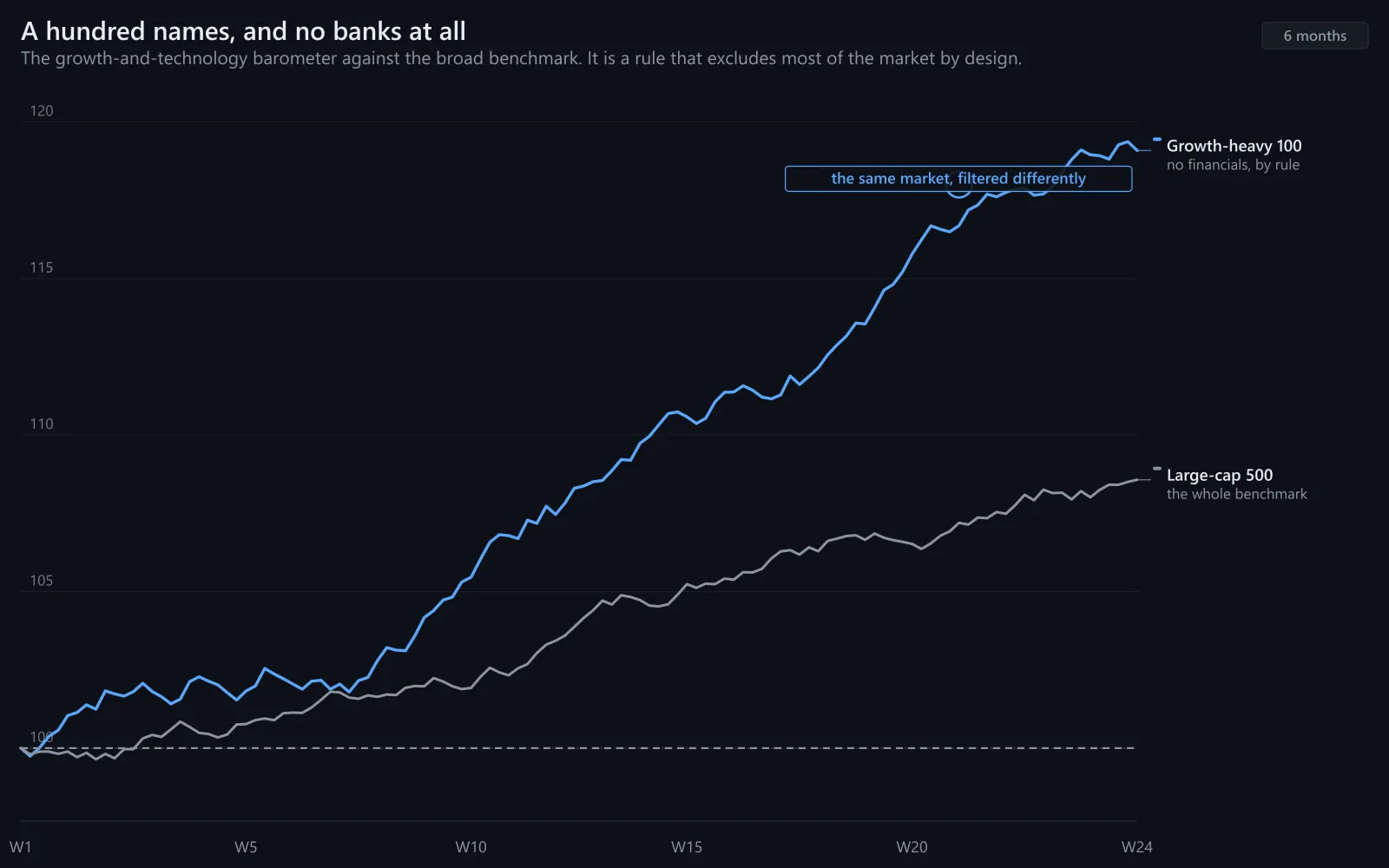
The Nasdaq-100 is an index of the hundred largest non-financial companies listed on the Nasdaq exchange, weighted by market value. Because the Nasdaq is where most large technology companies list, the index is dominated by technology, communication services and consumer companies with a growth profile. Banks and insurers are excluded by rule.
QQQ is the ETF that owns those hundred stocks in index proportion. It is one of the most actively traded securities in the world and the instrument most traders mean when they say 'tech' or 'growth'.
Its concentration is even heavier than the S&P 500's: a handful of the largest companies routinely make up close to half the index. When they move, QQQ moves, whatever the other ninety do.
02Why it exists
The index exists to represent the Nasdaq's largest companies as a group, and it became important because that group came to define a style: growth. As investors increasingly sorted the market into 'growth' and 'value', QQQ became the cleanest way to own or trade the first.
It also exists as a sentiment gauge. Growth companies are valued on expectations about the future, and expectations are what move most when interest rates, confidence or risk appetite change. QQQ is where those changes are felt first and hardest.
03How it is measured or observed
QQQ is read against the broad market and against the things that move growth valuations:
- QQQ vs SPYThe growth-versus-broad-market ratio. Rising = growth leading; falling = growth lagging. The single most watched relative line in the market.
- Top holdings' weightThe share of the index held by the largest five or ten companies. The higher it is, the more QQQ is a bet on a few names.
- Interest rates (10-year yield)Growth stocks are valued on distant earnings, so rising long-term yields tend to hurt them more than value stocks. QQQ often moves opposite to yields on rate-driven days.
- Semiconductor indexChips lead technology; the semiconductor group often leads QQQ up and down.
- Equal-weight Nasdaq-100The same hundred stocks counted equally. When it lags QQQ, the giants are carrying the index.
- VolatilityQQQ is typically more volatile than SPY; its implied volatility (the VXN) runs higher than the VIX.
Read · seeing it in the market
04How professionals read it
Professionals read QQQ first as a ratio. QQQ over SPY rising tells them growth is leading and the market is paying for the future — usually a risk-on, falling-or-stable-rates environment. The ratio falling tells them the opposite: value, cyclicals or defensives are leading and growth is being sold.
They watch its relationship with yields closely. On days when the 10-year yield jumps, they expect QQQ to underperform; when it falls, to outperform. When that relationship breaks — QQQ rallies through rising yields — something else is driving, usually earnings or a specific catalyst in the giants.
They also treat it as the index of the leaders. Because its largest members are the market's largest companies, QQQ's behaviour at the open and the close sets the tone for thousands of growth and technology stocks. A trader in a semiconductor name is really trading QQQ with extra volatility.
05What strength looks like
QQQ strength looks like growth leadership: the QQQ/SPY ratio rising, semiconductors leading, pullbacks shallow and bought, and the largest names making highs together — ideally with the equal-weight version keeping pace, so the leadership is broad inside the index.
Illustrative. QQQ (gold) outpaces SPY (navy) — the growth-over-broad ratio is rising.
Source: illustrative teaching data — not market data
06What weakness looks like
QQQ weakness looks like growth being sold: the ratio falling, semiconductors lagging, rallies that fail, and the giants falling harder than the market. It often coincides with rising long-term yields or a shift toward defensive leadership.
Illustrative. After the midpoint yields (grey) climb and QQQ (gold) falls behind SPY (navy).
Source: illustrative teaching data — not market data
07What a divergence looks like
The divergence worth watching is QQQ making new highs while its equal-weight version and the semiconductor group do not. The index is being carried by its largest members alone — the narrowest possible form of growth leadership, and the most fragile.
Broad
- Equal-weight Nasdaq-100 near highs too
- Semiconductors confirming
- QQQ/SPY ratio rising with breadth
- Several growth industries leading
Giant-only
- Equal-weight lagging
- Semis flat or down
- Top five weight climbing
- One or two names explain the move
What to check when QQQ makes a high.
Interpret · what it means for you
08What it means for an investor
For an investor QQQ is a concentrated growth holding, not a diversified one. Its record includes strong long-term returns and deep drawdowns — the decline after 2000 took years to recover. Owning it means accepting that you are betting on the continued leadership of a small number of large growth companies.
A growth index has historically shown higher highs and deeper lows than the S&P 500. That describes the past, not the future.
09What it means for a trader
For a trader QQQ is the tape to watch for any growth or technology stock. A breakout in a software name on a day QQQ is losing VWAP is swimming upstream. The Advanced program reads QQQ and SPY side by side before the first trade of the day.
It is also the clearer read on rate-driven days: when yields are the driver, QQQ's reaction tends to be faster and larger than SPY's, which also makes it the riskier trade.
10What it cannot tell you
- It is not 'the tech sector'. It excludes financials by rule, includes large consumer and communication companies, and misses technology companies listed elsewhere.
- Its moves are dominated by a few giants. A strong QQQ does not mean a strong average growth stock.
- Growth leadership can persist for years or reverse in a quarter. The ratio describes; it does not forecast.
- Higher long-term returns came with larger drawdowns. Past leadership is not a guarantee.
Apply · the market right now
11What is happening right now
MAAL TRADING ACADEMY market note
No dated note has been published for this topic yet. We only publish current-market commentary written and dated by the academy — nothing auto-generated.
Data · previous close
Live levels for QQQ, SPY, QQQE, SMH appear here once the licensed market-data feed is connected. We do not show unlicensed or made-up numbers.
How to check this yourself today
- Chart QQQ divided by SPY over six months. Is the ratio rising or falling?
- Compare QQQ with its equal-weight version (QQQE) over one month.
- Note the 10-year yield's direction over the last two weeks and whether QQQ moved opposite to it.
- Check the semiconductor ETF (SMH or SOXX) against QQQ — are chips leading?
12Visual market example
The growth-versus-market picture in one chart: QQQ leads while rates are stable, then lags as yields rise. The S&P barely notices. A trader in growth names who reads only the S&P would have missed the change entirely.
Illustrative. The growth index is the one that reacts when rates move.
Source: illustrative teaching data — not market data
Review · practise, keep, connect
13Test your understanding
Read the chart the way you would before a trade. Pick the answer, then read why.
1The 10-year yield jumps sharply on an inflation report. Which index would you expect to fall the most, and why?
Illustrative.
Source: illustrative teaching data — not market data
2QQQ is at a new high. Equal-weight Nasdaq-100 is down 3% on the month and semiconductors are flat. How broad is the leadership?
Illustrative.
Source: illustrative teaching data — not market data
14Key takeaways
- QQQ is the hundred largest non-financial Nasdaq companies, heavily concentrated in a few giants — the growth barometer.
- Read it as a ratio against SPY: rising means growth is leading.
- It is the most rate-sensitive major index; watch the 10-year yield beside it.
- Check equal-weight and semiconductors to see whether growth leadership is broad or giant-only.
- Higher long-term returns have come with deeper drawdowns. Know which you are signing up for.
16Learn it in class
Advanced Program · Stage 1 · Finding Stocks in Play
In the Advanced program, QQQ and SPY are on screen side by side from the first minute — every growth name on the watchlist is read against QQQ before it is traded.