
Understand · what it is and why it exists
01What it is
'Risk-on' describes a market where participants are reaching for return: buying small caps, growth stocks, high-yield bonds, speculative names. 'Risk-off' describes the opposite: money moving to large, stable, dividend-paying companies, to Treasuries, to the dollar, to cash.
Tone is not the same as direction. A market can rise in a risk-off tone (led by utilities and staples) and fall in a risk-on tone (a sharp pullback in a speculative rally). Tone describes what is being rewarded; direction describes where the index went.
It is one of the most useful single readings a trader can take, because it describes which kinds of moves the market is currently rewarding.
02Why it exists
Tone exists because every participant is constantly choosing between return and safety, and those choices move in waves. When the economy looks strong and rates are stable, reaching for return feels cheap; when growth slows or something breaks, safety feels cheap. The aggregate of those decisions is the tone.
It shows up across markets at once — stocks, bonds, currencies, commodities — because the same fear or confidence drives all of them. That is why tone is read from several instruments rather than one.
03How it is measured or observed
Tone is read from relationships, not levels. The pairs professionals watch:
- Small caps vs large caps (IWM vs SPY)Small companies are more fragile and more domestic. When they lead, appetite is high; when they lag sharply, it is not.
- Growth vs defensive sectorsTechnology and discretionary leading = risk-on. Utilities, staples and healthcare leading = risk-off.
- High-yield vs Treasury bondsWhen junk bonds hold up relative to Treasuries, credit markets are calm. When they sell off, stress is building — often before stocks notice.
- The VIXExpected volatility. Low and falling = complacent or calm; rising sharply = fear arriving.
- The dollar and goldA rising dollar and rising gold together often mean safety is being bought. Neither is a clean signal on its own.
- Speculative namesThe most volatile, story-driven stocks. When they rip, appetite is high; when they are sold hardest, it has gone.
Read · seeing it in the market
04How professionals read it
Professionals read tone as a weight of evidence. No single pair decides it. Small caps leading, high-yield calm, VIX low and growth sectors on top together make a risk-on reading; one of those alone is noise. They look for several pairs pointing the same way.
They also read the change more than the level. Tone that has been risk-on for months tells you little; tone that was risk-on and is turning — small caps start lagging, credit spreads widen, defensives start leading — tells you the environment is shifting, and shifts are where an approach stops fitting.
What they do not do is treat risk-off as 'bad'. A risk-off tone is an environment, and some strategies are built for it. A common mismatch is running risk-on ideas — chasing breakouts in speculative names — after the tone has turned.
05What strength looks like
Risk-on looks like breadth: small caps leading large, growth sectors leading defensives, high-yield bonds calm, the VIX low, and speculative names outperforming. Pullbacks are bought quickly. The crowd wants return and is willing to pay for it.
Illustrative. IWM (blue) outpaces SPY (navy) — appetite for risk is high.
Source: illustrative teaching data — not market data
06What weakness looks like
Risk-off looks like a retreat to quality: small caps lagging, defensives leading, high-yield bonds weakening against Treasuries, the VIX rising, and the most speculative names sold hardest. The index may still be near highs — for a while.
Illustrative. After the midpoint small caps (blue) roll over while staples (grey) lead and SPY (navy) holds — tone has turned.
Source: illustrative teaching data — not market data
07What a divergence looks like
The divergence to respect is the index at highs while tone has gone risk-off: small caps down, credit weakening, defensives leading. The headline and the tone disagree. It is not a timer, but it is the environment in which highs tend not to hold.
Risk-on
- Small caps lead large caps
- Growth sectors lead defensives
- High-yield calm vs Treasuries
- VIX low or falling
- Speculative names outperform
Risk-off
- Small caps lag sharply
- Defensives lead
- High-yield weakens vs Treasuries
- VIX rising
- Speculative names sold hardest
Several of these, not one.
Interpret · what it means for you
08What it means for an investor
For a long-term investor, tone is mostly a reminder that the market's mood swings and that plans should be made for both moods in advance. Risk-off periods are when many long-term plans are abandoned; knowing the tone has turned — and deciding beforehand that you will do nothing — is a discipline, not a signal.
09What it means for a trader
For a trader, tone decides which playbook is open. Risk-on tends to put the crowd behind breakouts in growth names, and dips get bought. Risk-off tends to bring the opposite: breakouts struggle, strength gets sold, and relative strength in defensive names is where the steadier moves are. A risk-on approach in a risk-off tone is a common mismatch.
10What it cannot tell you
- Tone is not direction. Risk-off markets rise; risk-on markets fall.
- It cannot tell you how long the tone lasts. Shifts can be days or years.
- One pair is not a reading. Small caps lagging for a week is noise; small caps lagging while credit weakens and defensives lead is a reading.
- Tone is not a reason to predict a crash or a boom. It describes appetite, not outcomes.
Apply · the market right now
11What is happening right now
MAAL TRADING ACADEMY market note
No dated note has been published for this topic yet. We only publish current-market commentary written and dated by the academy — nothing auto-generated.
Data · previous close
Live levels for SPY, IWM, HYG, XLU, XLK appear here once the licensed market-data feed is connected. We do not show unlicensed or made-up numbers.
How to check this yourself today
- Compare IWM with SPY over one and three months.
- Rank the sector ETFs: are cyclicals or defensives on top?
- Compare a high-yield bond ETF (HYG) with a Treasury ETF (IEF) over the last month.
- Note the VIX level and its direction over two weeks.
12Visual market example
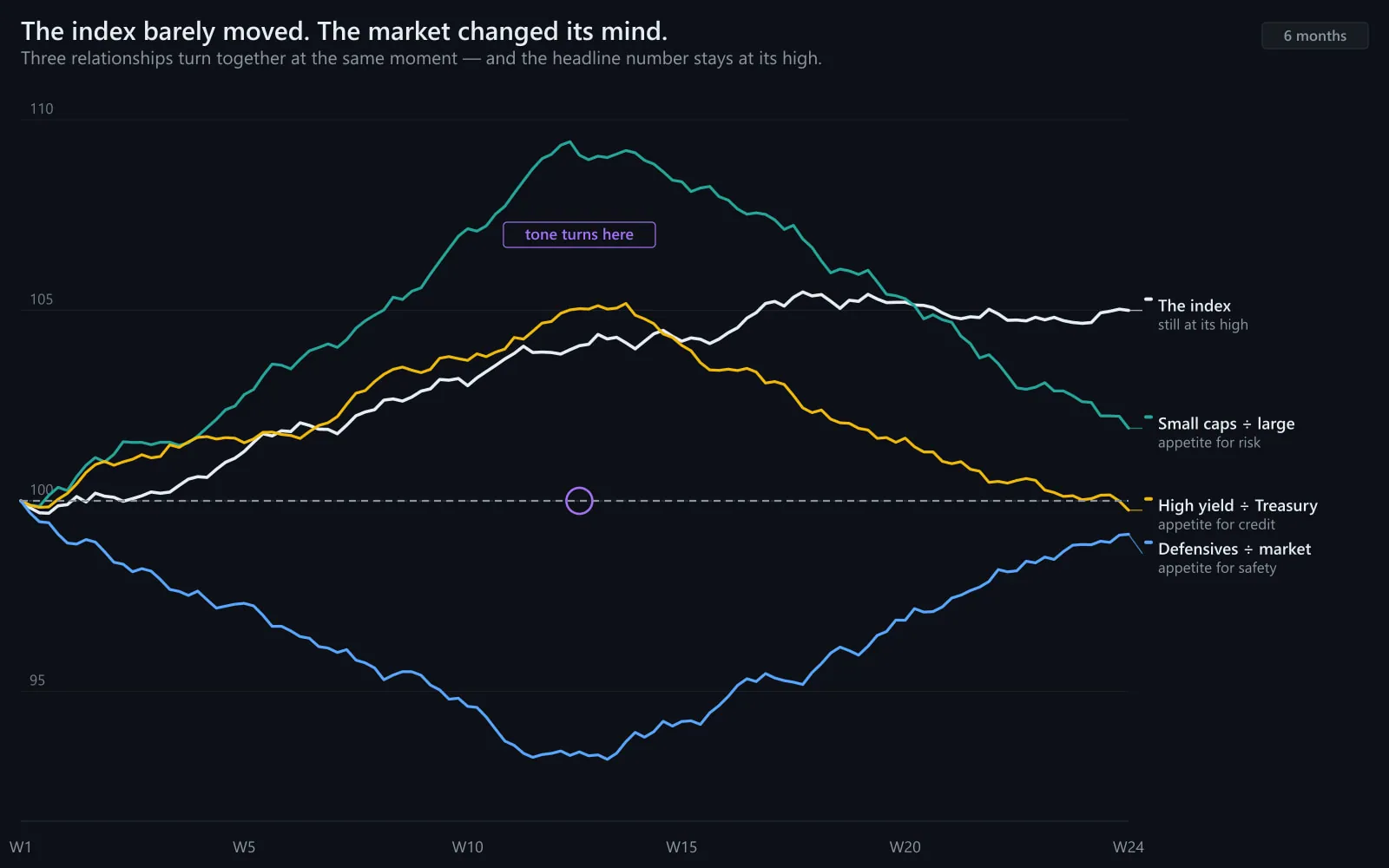
A tone shift in one picture: small caps lead the market higher, then roll over while staples begin to outperform and the index flattens. Nothing dramatic happens to the headline. Underneath, appetite has changed — and the approaches that suited the first half stop suiting the second.
Illustrative. The index (navy) barely changes; the tone underneath it does.
Source: illustrative teaching data — not market data
Review · practise, keep, connect
13Test your understanding
Read the chart the way you would before a trade. Pick the answer, then read why.
1Small caps are lagging, utilities lead, high-yield bonds are falling against Treasuries and the VIX is rising. The S&P is at a high. What is the tone?
Illustrative.
Source: illustrative teaching data — not market data
14Key takeaways
- Tone is what the market is rewarding — return or safety — not which way the index went.
- Read it from several pairs at once: small vs large, growth vs defensive, high-yield vs Treasuries, the VIX.
- The change in tone matters more than the level.
- Tone shapes what traders look for: breakouts in risk-on, relative strength and patience in risk-off.
- Tone describes appetite. It does not predict outcomes or timing.
16Learn it in class
Advanced Program · Stage 1 · Finding Stocks in Play
Advanced Day 1 begins with the tone: before a watchlist is built, the class reads small caps, sectors and the VIX to decide which kinds of setups suit the day.