
Understand · what it is and why it exists
01What it is
A failed breakout is a move through a level — the opening-range high, yesterday's high, a round number — that does not hold: price pushes through, stalls, and comes back inside. The participants who bought the break are now above the market and underwater. Their exit fuels the move back through the range.
On a range day failed breakouts are the rule, not the exception. The first one is the day's signature; the second confirms it. By the third, anyone still buying breaks is trading against what the day has shown.
02Why it exists
Failed breakouts exist because a level attracts two kinds of orders: the stops and buy-orders of people who want the break, and the sell-orders of people who see the level as a fair edge. When there is no imbalance behind the break — no catalyst, no participation — the second group wins, and the first group's exit becomes the reversal. The failure is the absence of an imbalance, made visible.
03How it is measured or observed
What a failure looks like while it is happening:
- The pushPrice clears the level, often quickly, on a burst of volume.
- The stallFollow-through does not arrive. Bars above the level overlap; volume dries up; the tape slows.
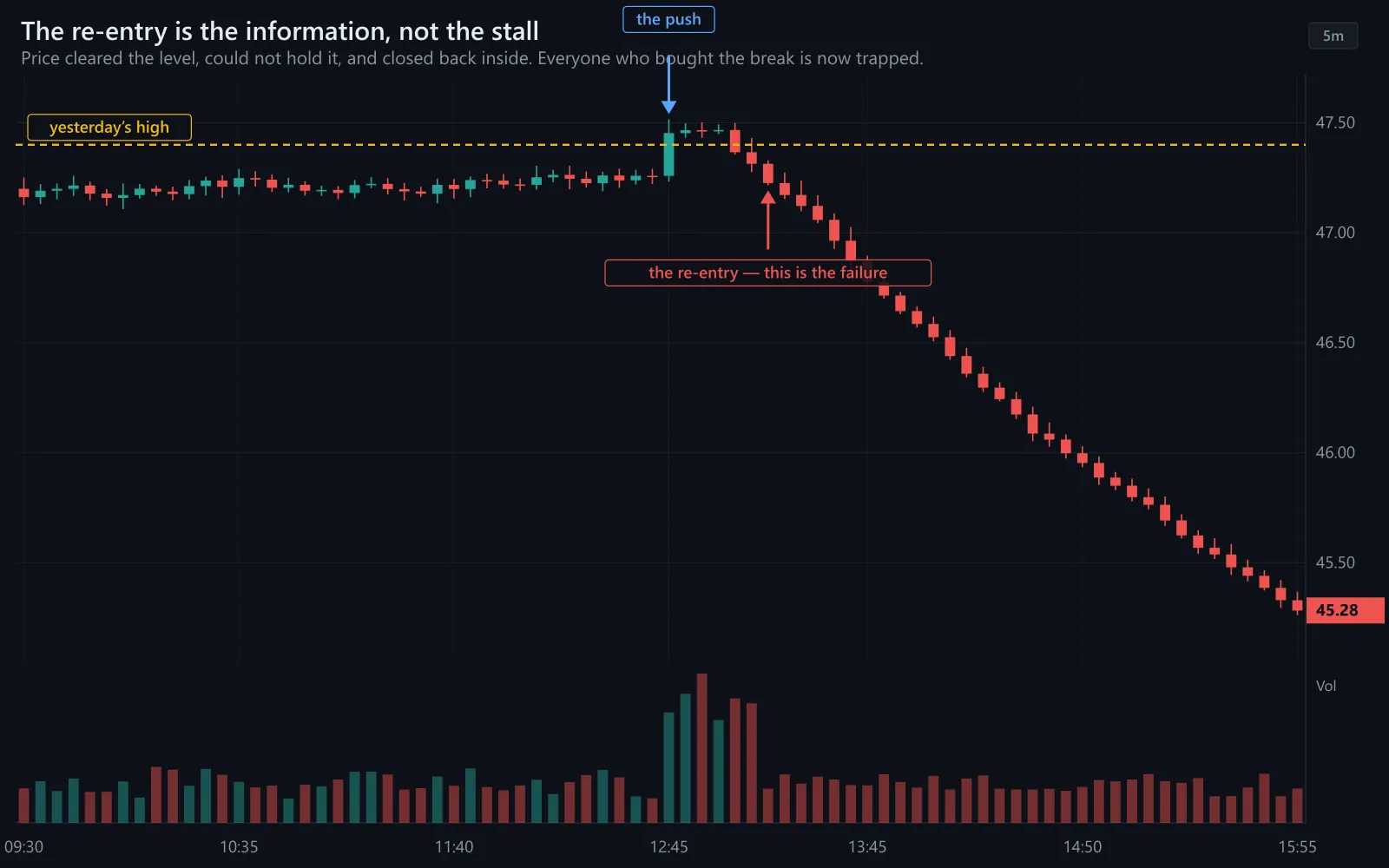
- The re-entryPrice closes back inside the range. This is the failure — not the stall, the re-entry.
- The reclaimThe other side's level — often VWAP or the middle of the range — is retaken, and the trapped participants exit into it.
Read · seeing it in the market
04How professionals read it
Professionals read the first failed breakout as the day's label. It does not matter how good the break looked; a break that re-enters the range on the first try says the market has no imbalance, and many shift their working plan from chasing the edges to watching for reactions at them.
They also study failures as possible setups — in the Advanced program, under Executing Reversals. A failed breakout with trapped participants, a close back inside the range and a reclaim of the middle is structure; 'it went up too much, so short it' is not. The difference is whether the failure is visible on the chart or only in a feeling.
And they read the failure's volume. A break on thin volume that fails is expected; a break on heavy volume that fails is more significant — a lot of participants just got trapped, and the reversal has more fuel.
05What strength looks like
A failed breakout done cleanly: price pushes above the band, stalls on shrinking volume, closes back inside, and returns to VWAP as the trapped buyers exit. The day has declared itself a range day, and the failure itself was structure a trader could read.
Illustrative. Price (navy) clears the band, stalls, re-enters, and returns to VWAP (gold).
Source: illustrative teaching data — not market data
06What weakness looks like
The mistake is treating a failure as a trend-day breakout that merely needs patience — adding above the level, widening the stop, waiting for the follow-through that never comes. On a range day the break tends to be the mismatched trade; the re-entry was the information, and it was ignored.
Breakout that holds (trend day)
- Volume expands through the level
- Follow-through within minutes
- Pullback holds above the level
- Breadth and VWAP agree
Failed breakout (range day)
- Volume spikes, then dies
- Bars above the level overlap and stall
- Close back inside the range
- VWAP reclaimed by the other side
What separates the two while they are happening.
Interpret · what it means for you
07What it means for an investor
For an investor a failed breakout is mostly a reminder not to buy the excitement of a level being broken. Prices that spike through a well-known number and fall back are common; a limit order inside the range usually fills better than a market order placed at the moment of the break.
08What it means for a trader
For a trader a failed breakout is two things: a warning that the day leans range and chasing tends to be costly; and, when the failure has real structure, a reversal setup the class studies with a defined stop above the failed high. The Advanced program spends an hour on exactly this — and an equal hour on why 'it went too far' is not structure.
09What it cannot tell you
- A single failure does not forbid a later breakout that holds; it changes the odds and the label, not the rules.
- A failure on a scheduled catalyst behaves differently from one on nothing.
- Failures need volume context: a thin-volume failure is ordinary, a heavy-volume failure is significant.
Apply · the market right now
10What is happening right now
MAAL TRADING ACADEMY market note
No dated note has been published for this topic yet. We only publish current-market commentary written and dated by the academy — nothing auto-generated.
Data · previous close
Live levels for SPY, QQQ appear here once the licensed market-data feed is connected. We do not show unlicensed or made-up numbers.
How to check this yourself today
- On SPY, find the first break of the opening range today: did it hold or re-enter?
- Mark yesterday's high and low. Has either been broken and reclaimed?
- For the last failure, note the volume on the push versus the stall.
- Count the failed breaks so far: one is a clue, two is a label.
11Visual market example
The push, the stall, the re-entry, the reclaim — four stages that take ten to thirty minutes and say a great deal about the day. The trader who waits for the re-entry before deciding is late to the break and early to the truth.
Illustrative. A burst on the push, shrinking through the stall, a second burst on the re-entry as trapped buyers exit.
Source: illustrative teaching data — not market data
Review · practise, keep, connect
12Test your understanding
Read the chart the way you would before a trade. Pick the answer, then read why.
1Price broke yesterday's high on a volume spike, spent fifteen minutes in overlapping bars above it on shrinking volume, and just closed back below it. What has the day told you, and what is the valid response?
Illustrative.
Source: illustrative teaching data — not market data
13Key takeaways
- A failed breakout is a break that closes back inside the range; the re-entry is the information.
- The first failure labels the day; the second confirms it.
- Failures with trapped participants and a reclaim are what the class studies as reversal structure; 'it went too far' is not.
- Read the failure's volume: thin failures are ordinary, heavy ones are significant.
15Learn it in class
Advanced Program · Stage 6 · Executing Reversals
Advanced: failed breakouts and breakdowns, rejection, exhaustion, reclaiming a level — and the class rule that 'it went up too much, so short it' is not structure.