
Understand · what it is and why it exists
01What it is
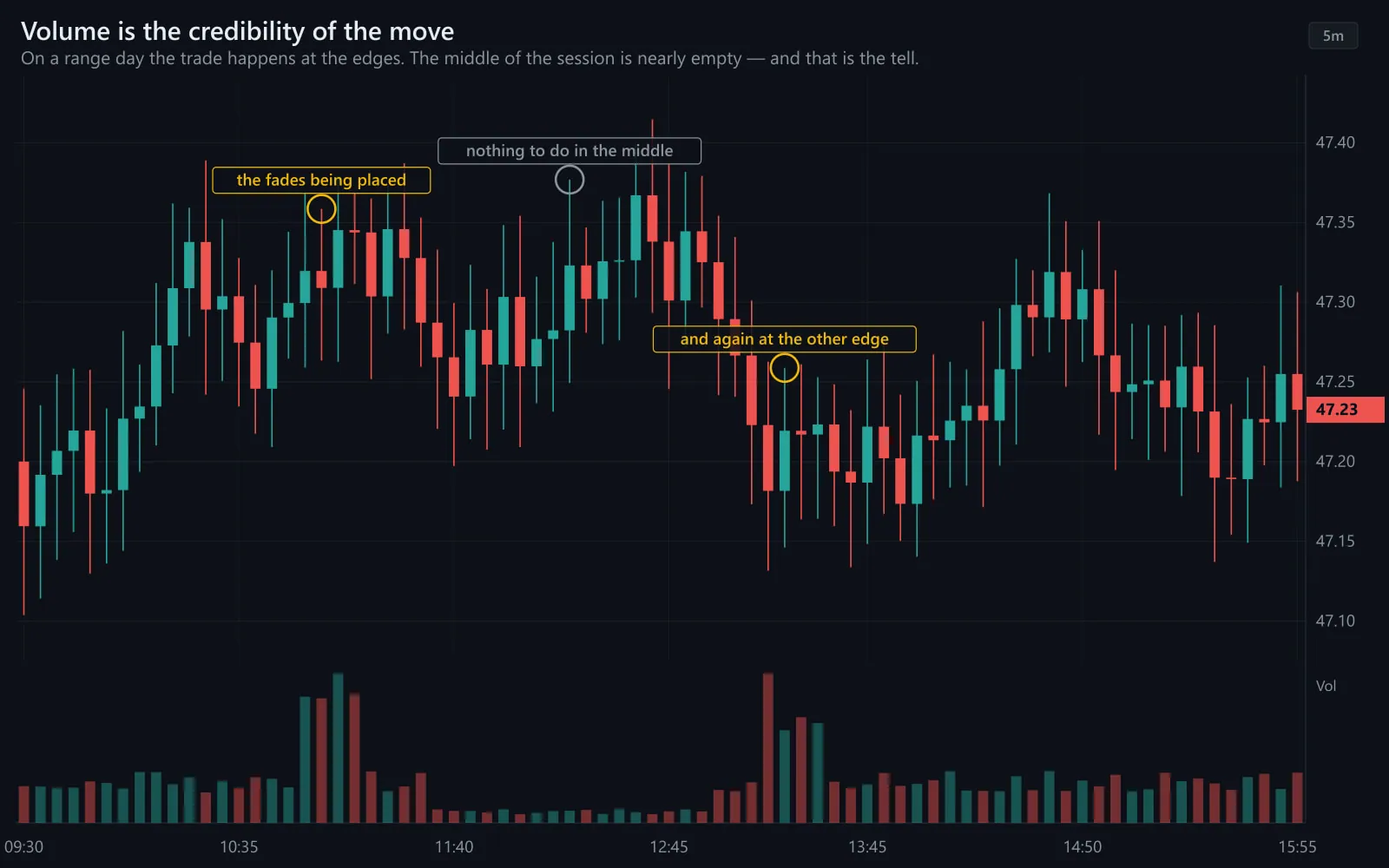
Volume behaviour is the pattern of participation through the session: not just how much traded, but when. On a trend day volume expands with the move and stays elevated; on a range day it spikes at the edges of the band — where fades are placed — and disappears in the middle, where nothing happens.
Read against the time of day, that shape is one of the more honest labels a session provides, because volume is hard to fake and easy to see.
02Why it exists
Volume behaves this way because participation follows conviction. When one side has an imbalance, more participants keep joining as price moves, and volume grows with the move. When prices are merely being accepted inside a band, the only reason to act is a test of the band's edge — so volume arrives at the edges and leaves in between.
03How it is measured or observed
What to look at, and what to compare it with:
- Relative volumeToday's volume against the average for the same time of day. A 10:00 bar can only be judged against other 10:00 bars.
- Volume with the moveIs volume higher on bars moving in the day's direction than on bars moving against it? Yes is trend behaviour.
- Edge spikesVolume concentrated at the high and low of the band, with quiet in the middle — the range-day profile.
- Breakout volumeA break of a level on expanding volume is credible; a break on thin volume is the profile of a move that often reverses.
Read · seeing it in the market
04How professionals read it
Professionals read volume as the credibility of price. Movement with participation behind it is trusted; movement without it is suspected. On a trend day the volume keeps confirming, bar after bar, and the move is believed. On a range day each push to the edge arrives on a spike that then dies — the signature of a fade, not a breakout.
They always compare against the time-of-day baseline. Volume is naturally heaviest at the open and close and lightest around midday; a 'big' bar at 12:30 may be ordinary, and a 'quiet' bar at 9:00 may be a warning. The shape of the day matters more than any single number.
And they use it to grade breakouts. A level broken on expanding volume has participation behind it; the same break on thin volume is a question, and such moves often fail to hold. Price action + volume + Level II + tape — never price alone.
05What strength looks like
Volume on a trend day: heavy at the open, sustained through the morning as the move extends, a normal midday lull that does not reverse the move, and expansion into the close as trapped participants give up. Every leg has participation behind it.
Illustrative. Heavy open, sustained participation, expansion into the close.
Source: illustrative teaching data — not market data
06What weakness looks like
Volume on a range day: spikes at the open, at each test of the band's edges, and at the close — and very little in between. The spikes are the fades being placed; the quiet is the market agreeing that nothing has changed.
Illustrative. Spikes at the edges, quiet in the middle.
Source: illustrative teaching data — not market data
Interpret · what it means for you
07What it means for an investor
For an investor volume is mostly a liquidity check: a stock that trades a few thousand shares a day will fill badly and move on small orders, whatever its chart says. Beyond that, a big move on heavy volume is more likely to reflect real information than the same move on a quiet day.
08What it means for a trader
For a trader volume is the column that most often says NO TRADE. In the Advanced framework a breakout without it is not treated as a valid setup; a trend-day label without it is a weak label; a fade at the edge of a range is more credible when the spike arrives on schedule. The Advanced program's tape session is about exactly this: whether the volume confirms the price.
09What it cannot tell you
- Volume measures participation, not direction.
- A single bar is noisy; the shape of the day is the information.
- Volume can be heavy because participants are wrong, not because they are right.
Apply · the market right now
10What is happening right now
MAAL TRADING ACADEMY market note
No dated note has been published for this topic yet. We only publish current-market commentary written and dated by the academy — nothing auto-generated.
Data · previous close
Live levels for SPY, QQQ appear here once the licensed market-data feed is connected. We do not show unlicensed or made-up numbers.
How to check this yourself today
- On SPY, compare the first-hour volume with the first hour of the last five sessions.
- Note whether bars moving in the day's direction are heavier than bars moving against it.
- Find the day's high and low so far: did volume spike there and fade after?
- Check the last breakout of a key level: did volume expand or not?
11Visual market example
Two volume profiles for two kinds of day. The trend day's volume is a plateau with a rising edge; the range day's is a row of spikes with empty space between. The profile alone often suggests the label by early afternoon — and the profile is always visible.
Trend day
- Heavy open that does not fade
- Volume higher on bars with the move
- Ordinary midday lull; move resumes
- Expansion into the close
Range day
- Heavy open, then quiet
- Spikes at each edge of the band
- Empty middle of the day
- Spike at the close, no follow-through
What the half-hour bars tend to look like.
Review · practise, keep, connect
12Test your understanding
Read the chart the way you would before a trade. Pick the answer, then read why.
1At 12:20 a stock breaks a key level by 0.5% on volume that is 40% of its usual pace for that time of day. Valid setup?
Illustrative.
Source: illustrative teaching data — not market data
13Key takeaways
- Volume is the credibility of a move; read it against the time-of-day baseline.
- Trend days: volume expands with the move and sustains. Range days: spikes at the edges, quiet in the middle.
- A breakout without volume often fits the profile of a move that reverses.
- Volume is the column that most often says NO TRADE.
15Learn it in class
Advanced Program · Stage 2 · Advanced Orders & Level II / Tape
Advanced Day 1: the tape — speed, size, and whether volume confirms the price. Level II and the tape are context, not predictors.