
Understand · what it is and why it exists
01What it is
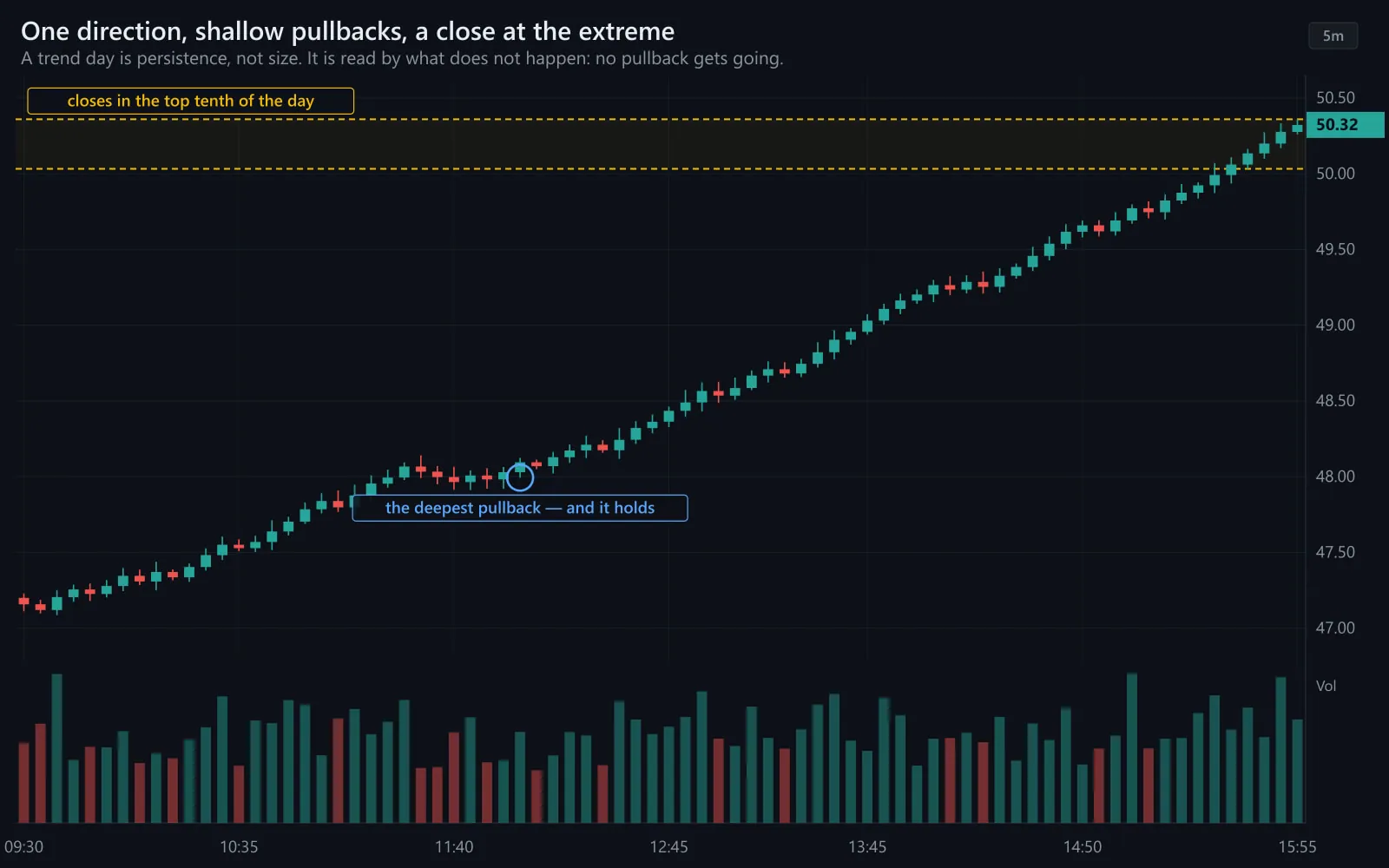
A trend day is a session in which price moves from one end of its range to the other and stays there: it opens near one extreme, closes near the opposite one, and the pullbacks along the way are shallow and short. The open is not revisited. The high (or low) keeps being replaced.
It is not defined by size. A trend day can be a quiet 0.6% grind or a 3% rout; what makes it a trend day is persistence — the same side keeps winning every time the other side tries.
Genuine trend days are a minority of sessions, which is exactly why they matter: most of a month's index movement happens on a handful of them.
02Why it exists
A trend day exists because one side has an imbalance the other side cannot absorb inside a single session: a surprise in the data, a shift in rates, a large participant repositioning across the whole day, or a crowd caught on the wrong side and forced to unwind. Each pullback meets the same persistent pressure, so the move resumes.
03How it is measured or observed
There is no indicator that labels the day. Professionals read a cluster of observations that are mostly visible within the first hour:
- Open locationPrice opens near one extreme of the day's eventual range and never returns to it. Opening gaps hold.
- Pullback depthRetracements recover a small fraction of the prior leg — often a third or less — and resolve within minutes, not hours.
- VWAP sidePrice stays on one side of the volume-weighted average price all session; touches of VWAP are bought (or sold) and hold.
- Range extensionThe opening range is broken early and the break is extended repeatedly through the day.
- Close locationThe close lands in the top (or bottom) tenth of the day's range.
Read · seeing it in the market
04How professionals read it
Professionals read a trend day by what does not happen. The pullback that should have gone deeper does not; the VWAP test that should have failed holds; the mid-morning lull that usually brings a reversal brings a new high instead. Each non-event is one more clue that the direction is intact.
They also read it early and conditionally. By the end of the first hour — an opening gap that held, an opening-range break that extended, breadth one-sided — the working label is 'trend'. The label is held loosely: if price loses VWAP and the next high fails, the label is dropped without argument.
And they resist the urge to call the top. On a trend day, 'it has gone too far' is a feeling, not a setup. Strong sessions tend to accelerate into the close as trapped participants give up.
05What strength looks like
A clean trend day: the gap holds, price leaves the opening range and never re-enters it, every pullback to VWAP is absorbed, breadth widens through the afternoon, and the close is within a few ticks of the high.
Illustrative. Price (navy) holds above VWAP (gold) all session; pullbacks are shallow; the close is near the high.
Source: illustrative teaching data — not market data
06What weakness looks like
A trend day down has the same shape upside down — and tends to be faster, because fear clears faster than greed. Rallies toward VWAP are sold, every bounce ends below the last, and the close is near the low. Fading it because 'it is oversold' is the mirror image of calling the top.
Illustrative. Price (navy) stays below VWAP (gold); rallies fail; the close is near the low.
Source: illustrative teaching data — not market data
Interpret · what it means for you
07What it means for an investor
For an investor a trend day is mostly an execution note: a market order placed in the first minutes of a strong trend day tends to fill worse than a patient limit order later, and a position sold in the panic of a trend day down is often sold near the low. The plan does not change; the order type might.
08What it means for a trader
For a trader a trend day is the session where matching approach to condition matters most. In class we study pullbacks toward VWAP, how shallow dips behave, and why fading strength on such a day tends to be costly. The Advanced program replays opening sessions precisely so you can recognise this shape while it is still forming.
09What it cannot tell you
- It cannot be known at the open; the first hour gives a working label, not a certainty.
- A trend day in the index does not guarantee a trend in your stock, and a range day does not forbid one.
- Yesterday's trend day says nothing about today.
Apply · the market right now
10What is happening right now
MAAL TRADING ACADEMY market note
No dated note has been published for this topic yet. We only publish current-market commentary written and dated by the academy — nothing auto-generated.
Data · previous close
Live levels for SPY, QQQ appear here once the licensed market-data feed is connected. We do not show unlicensed or made-up numbers.
How to check this yourself today
- On SPY, mark the opening range (first 15–30 minutes) and note whether price has left it and stayed out.
- Put VWAP on the chart: has price touched it since the first half hour, and did the touch hold?
- Check the pullbacks: what fraction of the prior leg did the deepest one give back?
- Look at the close location on the last five sessions — how many closed in the top or bottom tenth of their range?
11Visual market example
A trend day and a range day on the same scale. The trend day never spends long at VWAP and closes at its extreme; the range day lives on both sides of it and closes near where it opened. Same number of bars; opposite character — and opposite strategies.
Illustrative. Same session length; opposite behaviour.
Source: illustrative teaching data — not market data
Review · practise, keep, connect
12Test your understanding
Read the chart the way you would before a trade. Pick the answer, then read why.
1It is 10:30. Price gapped up, has not returned to the prior close, broke the opening range and has held two pullbacks above VWAP. What is the working label, and which response fights the clues?
Illustrative.
Source: illustrative teaching data — not market data
13Key takeaways
- A trend day is persistence, not size: one side keeps winning every test.
- Clues arrive early — gap holds, opening range left, pullbacks shallow, VWAP on one side.
- The close lands near the extreme; strong trend days tend to accelerate late.
- Fading a trend day because it has 'gone too far' is a feeling, not a setup.
15Learn it in class
Advanced Program · Stage 3 · Trading the Opening Bell
Advanced: replayed opening sessions, paused and rewound, where you say which kind of day it is becoming — and why.