
Understand · what it is and why it exists
01What it is
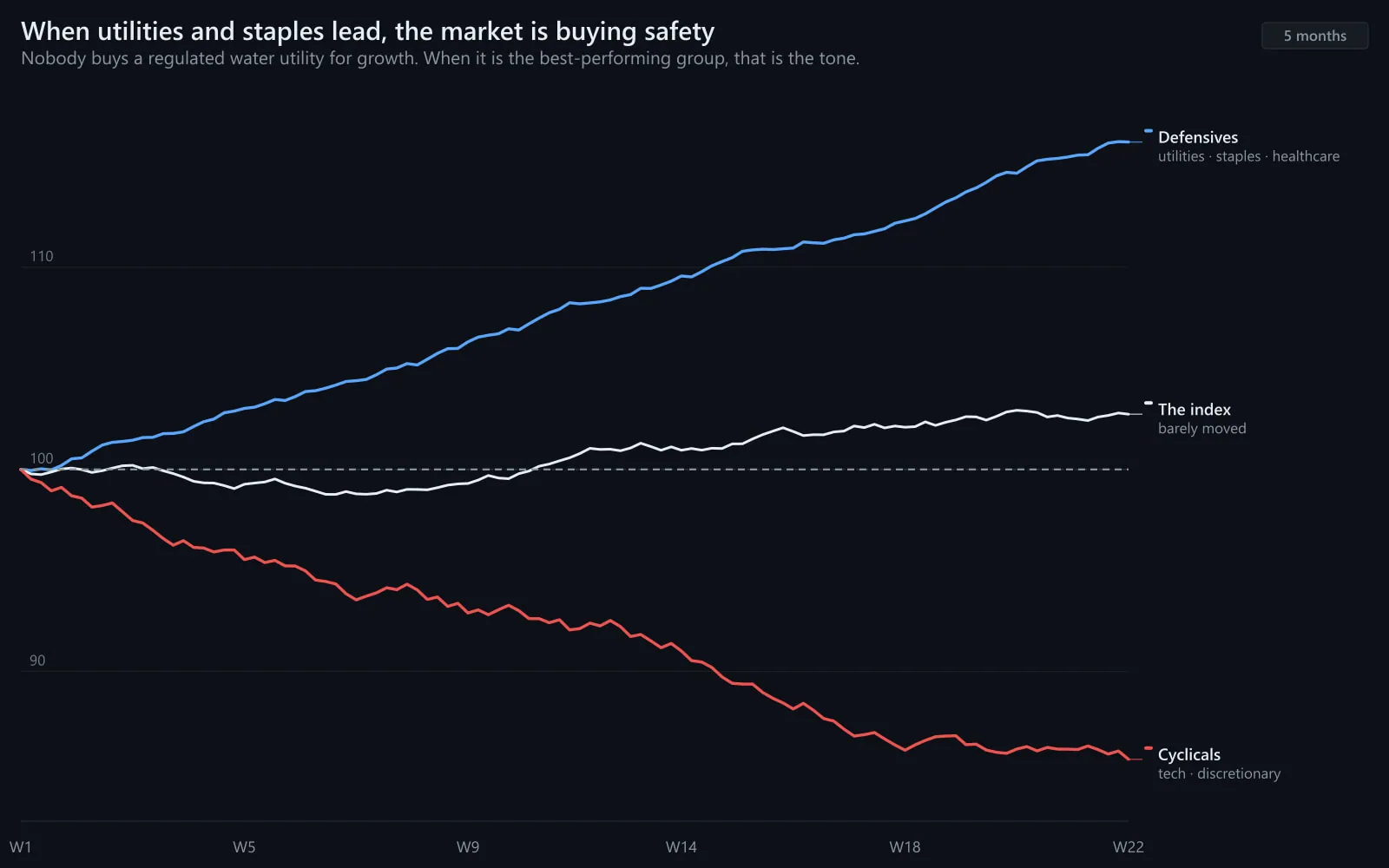
Defensive leadership is the condition in which the three sectors least tied to the economic cycle — utilities, consumer staples and healthcare — outperform the market. Investors are buying stability: dividends, predictable demand, low volatility. It is the market's caution tone made visible in the sector table.
It can occur in a rising market (safety being bought inside a rally) or a falling one (the defensives falling least). The first is a quiet warning; the second is the defensives doing their job.
02Why it exists
It exists because the three sectors' earnings barely change with the cycle, so when participants expect a slowdown, or simply want less volatility, they move into them. The tone shows up in relative performance before it shows up in the economy — which is the reason to read it.
03How it is measured or observed
How to confirm it:
- XLU, XLP, XLV vs SPYAll three ratio lines rising together.
- CompanionsVIX rising, small caps lagging, high-yield credit weakening, growth sectors at the bottom of the table.
- RatesIf the 10-year yield is falling, part of the move is a rate trade (utilities and REITs benefit); if yields are flat, it is cleaner fear.
- DurationOne week is noise; a month is a tone.
Read · seeing it in the market
04How professionals read it
Professionals read defensive leadership as a tone — participants want shelter — and then ask why: falling rates, rising fear, or slowing growth. Each has a different implication. They also ask whether the index is rising or falling while defensives lead: safety bought inside a rally is a quieter, earlier signal than safety bought in a decline.
They do not treat it as a sell signal. Defensive tone has persisted through long, rising markets. It changes sizing and setup selection; it does not decide direction.
05What strength looks like
Defensives doing their job: the index falls and the trio falls least or rises. The tone is caution, and the sectors are behaving exactly as they are owned to.
Illustrative. The defensive trio (gold) holds as SPY (navy) falls.
Source: illustrative teaching data — not market data
06What weakness looks like
The quieter version: the index at highs, defensives leading the one-week table, growth sliding. Safety being bought inside a rally — participants hedging without selling. The index looks fine; the tone has changed.
Reason
- Falling rates
- Rising fear (VIX, credit)
- Slowing growth expectations
Implication
- Rate trade: REITs and utilities lead; not necessarily caution
- Risk-off: traders often cut size and trust breakouts less
- Cyclicals at risk; read transports and industrials
Three reasons, three implications.
Interpret · what it means for you
07What it means for an investor
For an investor defensive leadership is a reminder that the market's mood has shifted — and a test of whether the plan was made for both moods. For many long-term plans it changes nothing.
08What it means for a trader
For a trader it changes the day's focus: fewer breakouts in growth names, more relative strength in the defensives themselves, smaller size. It is part of the Advanced morning tone check.
09What it cannot tell you
- It is not a sell signal; it has persisted through rising markets.
- It does not time a decline.
- Defensives can lead for rate reasons that have nothing to do with fear.
Apply · the market right now
10What is happening right now
MAAL TRADING ACADEMY market note
No dated note has been published for this topic yet. We only publish current-market commentary written and dated by the academy — nothing auto-generated.
Data · previous close
Live levels for XLU, XLP, XLV, SPY appear here once the licensed market-data feed is connected. We do not show unlicensed or made-up numbers.
How to check this yourself today
- Chart XLU, XLP and XLV each ÷ SPY over one month.
- Check the VIX and the 10-year yield over the same period.
- Is the index rising or falling while the trio leads?
11Visual market example
Defensives holding while the index falls: the plainest version of the tone. The reading is caution; for many long-term plans it changes nothing; for a trader it usually means smaller size and different setups to study.
Illustrative.
Source: illustrative teaching data — not market data
Review · practise, keep, connect
12Test your understanding
Read the chart the way you would before a trade. Pick the answer, then read why.
1Utilities, staples and healthcare lead the one-month table. The 10-year yield fell sharply in that time. The VIX is flat. Small caps rallied. What kind of defensive leadership is this?
Illustrative.
Source: illustrative teaching data — not market data
13Key takeaways
- Utilities, staples and healthcare leading together is the caution tone.
- Ask why: rates, fear, or growth — each means something different.
- Safety bought inside a rally is the quieter, earlier signal.
- A tone, not a sell signal; it changes size and playbook, not direction.
15Learn it in class
Advanced Program · Stage 1 · Finding Stocks in Play
The defensive trio is on the Advanced morning screen — their leadership changes which setups the class studies and at what size.