
Understand · what it is and why it exists
01What it is
Position sizing is deciding how many shares to hold so that, if the trade is wrong, the loss is an amount you chose in advance. Volatility is the input that decides it, because the distance to a sensible stop depends on how far the stock normally moves.
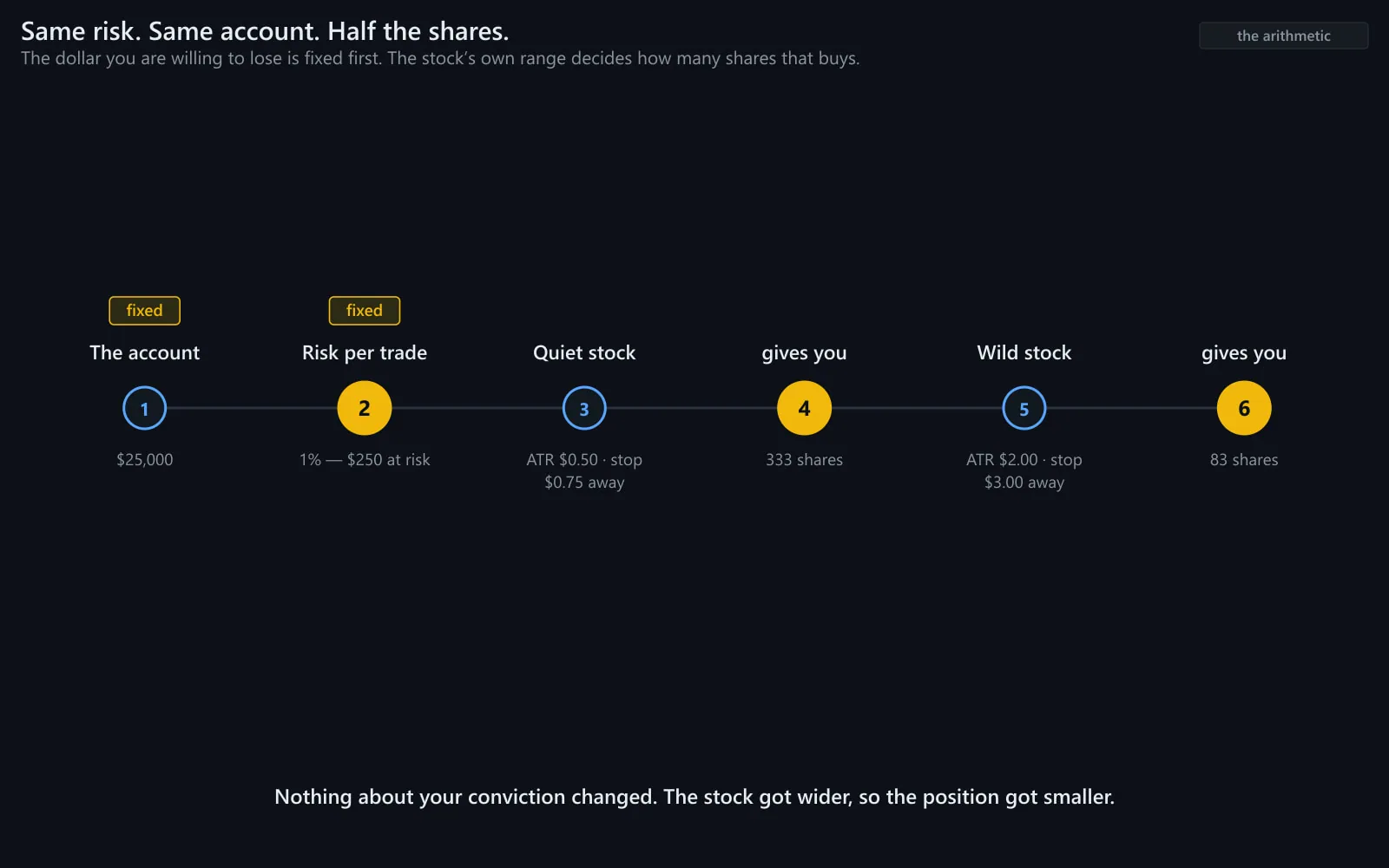
The rule: decide the dollar risk first (say 1% of the account — the Beginner program's 1% rule), measure the stop distance from the stock's range, then divide. Shares = dollar risk ÷ stop distance. A volatile stock gets a wider stop and therefore fewer shares; a calm one, the reverse.
02Why it exists
It exists because the alternative — buying a round number of shares, or the same number every time — ignores the one thing that decides how much a trade can lose. Two positions of 100 shares in a calm stock and a wild one are not the same risk; they might differ by four times. Sizing from volatility makes every trade carry the same risk, which is what makes a process reviewable.
03How it is measured or observed
The arithmetic, step by step:
- 1. Dollar riskA fixed fraction of capital per trade — the Beginner program uses a maximum of 1%. On $20,000, that is $200.
- 2. Stop distanceWhere the setup is wrong, expressed in dollars per share. It must respect the stock's range — typically 1–2× ATR, or the far side of a level.
- 3. SharesDollar risk ÷ stop distance. $200 ÷ $1.80 = 111 shares. $200 ÷ $7.20 = 27 shares.
- 4. Sanity checkShares × price = position size. If that exceeds what you are comfortable holding, the stop is too tight for the stock or the trade is too big — not a reason to widen the stop.
- 5. Recompute on regime changeIf ATR doubles, the stop doubles and shares halve. Yesterday's size is not today's.
Read · seeing it in the market
04How professionals read it
Professionals treat sizing as the non-negotiable part of every trade. The entry can be imperfect and the target can be a guess; the size cannot. It is the single control meant to keep one bad trade from mattering, and it is decided before the order, never after.
They read volatility as the variable that changes the answer. A doubling of ATR halves the position; a compression allows more shares for the same risk. Traders who keep share counts constant across regimes are, without noticing, doubling their risk exactly when the market gets dangerous.
And they check the math against the stop, not the other way round. Widening a stop to fit a desired position size is a common form of self-deception in trading; the stop goes where the setup is wrong, and the size follows from it.
05What strength looks like
Sizing done right: every trade risks the same dollar amount, calm and wild stocks alike, because the share count adjusts. The review at the end of the day compares decisions, not luck, because the risk per decision was constant.
Illustrative. The share count is the output of the arithmetic, never the input.
Source: illustrative teaching data — not market data
06What weakness looks like
Sizing done wrong: the same 100 shares in every name, stops placed 'where they look right', and a wild stock quietly carrying four times the risk of a calm one. One loss in the wild name can outweigh several in the calm one, and the review cannot tell whether the decisions were bad or just the size.
Illustrative. Constant shares means wildly inconsistent risk.
Source: illustrative teaching data — not market data
Interpret · what it means for you
07What it means for an investor
For an investor the same idea applies at portfolio scale: weight alone does not measure a position's risk. A 5% position in a 60%-volatility stock carries roughly the risk of a 20% position in a 15%-volatility fund. Equal dollar weights are not equal risk weights.
08What it means for a trader
For a trader this is central to the Beginner program and the foundation of every Advanced plan: Symbol → Setup → Entry → Stop → Position size → Target. Size is computed, written down, and never adjusted to make a trade feel better.
09What it cannot tell you
- Sizing cannot make a bad setup good; it only makes it survivable.
- ATR-based stops can still be hit by noise in expanding regimes — recompute.
- Gap risk exceeds any stop; sizing assumes the stop can be honoured.
Apply · the market right now
10What is happening right now
MAAL TRADING ACADEMY market note
No dated note has been published for this topic yet. We only publish current-market commentary written and dated by the academy — nothing auto-generated.
Data · previous close
Live levels for SPY appear here once the licensed market-data feed is connected. We do not show unlicensed or made-up numbers.
How to check this yourself today
- Pick a stock. Find its 14-day ATR. Set a stop at 1.5× ATR from a sensible level.
- Divide 1% of a hypothetical account by the stop distance — that is the share count.
- Now double the ATR and repeat. Notice what happened to the size.
11Visual market example
Three stocks, one rule, three share counts. The trader risks $200 on each; the market decides how many shares that buys. Nothing about the arithmetic requires a prediction, and everything about it is aimed at protecting the account.
Illustrative. Risk constant; shares variable.
Source: illustrative teaching data — not market data
Review · practise, keep, connect
12Test your understanding
Read the chart the way you would before a trade. Pick the answer, then read why.
1Account $25,000, max risk 1%. Stock at $80, 14-day ATR $2.00, stop placed 1.5× ATR below entry. How many shares?
Illustrative.
Source: illustrative teaching data — not market data
13Key takeaways
- Decide dollar risk first, stop distance from volatility second, shares by division third.
- Volatility changes the answer: double the ATR, halve the shares.
- Size follows the stop, not the reverse.
- Constant risk per trade is what makes a process reviewable.
15Learn it in class
Beginner Program · Stage 5 · Capital Protection
Beginner: the 1% rule, position sizing and stops — this page's arithmetic, by hand, before the first sized simulated trade.